Class A, Chapter 7A, and Why Your Neighbor's Roof Quote Looks Different
Two homes a few streets apart can face genuinely different roofing requirements. It is not the contractor being inconsistent. It is which side of a mapped line the house sits on.
A homeowner in Sunland once asked us why his quote listed items his brother's roof in Van Nuys never mentioned. Same company, same crew, same shingle. Different requirements. The difference was not the roof. It was the map.
Fire hazard severity zones, briefly
California maps areas by wildfire risk. Properties inside the higher hazard zones, and inside what is called the Wildland Urban Interface, fall under a distinct set of construction rules aimed at one specific threat: wind driven embers landing on a house during a fire.
Those rules live in Chapter 7A of the California Building Code, titled Materials and Construction Methods for Exterior Wildfire Exposure. As of 1 January 2026 the state's WUI provisions were also updated. If your property is in a mapped zone, a re-roof is not simply a re-roof.
Embers, not flames
This is the part that reframes the whole subject. Most homes lost in wildfires are not consumed by a wall of flame arriving at the property line. They ignite from embers, carried ahead of the fire, sometimes a long way, that land in a vulnerable spot and smoulder.
A roof is a large horizontal surface that catches whatever falls on it. That is why roofing sits at the center of these rules.
What Chapter 7A asks of a roof
The headline requirement is a Class A roof assembly, the highest fire classification, verified by standardized testing. The word assembly matters. It is not only the shingle. It is the shingle, the underlayment and the deck working together as a tested system. A Class A rated shingle installed over the wrong underlayment may not give you a Class A assembly.
Beyond the covering itself, these projects typically involve:
- Ember resistant venting. Ridge and eave vents are exactly the openings embers exploit. Vents designed and tested to resist ember intrusion replace ordinary ones.
- Attention to the eaves and edges. The roof edge, where the covering meets the fascia and the vents, gets specific treatment.
- Gutters that will not hold fuel. Non combustible gutters, often with covers, because a gutter packed with dry leaves is a firebed running along the edge of your roof.
- Underlayment specified for the assembly rather than whatever is on the truck.
Wood shakes and wood shingles are out. In mapped zones they are prohibited, and that generally holds even for pressure treated versions. If you have a wood shake roof in a hazard zone, you are not replacing like with like.
Which of our neighborhoods this touches
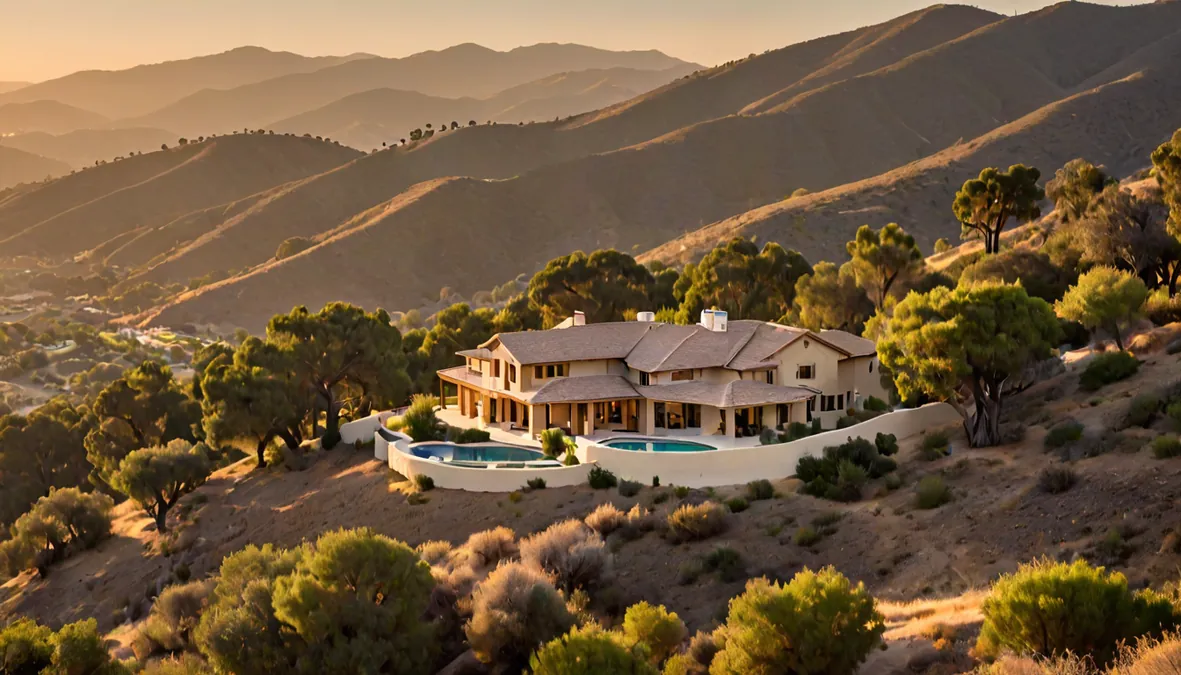
Hazard zones follow terrain, not city boundaries. In broad terms, the communities against the hills and canyons are the ones most likely to be affected: Sunland, Tujunga, Sylmar, Porter Ranch, Chatsworth, Calabasas, Agoura Hills, Canyon Country and parts of Santa Clarita.
But please do not use that list as your answer. Zone boundaries can run through a single street, and they are revised. The only reliable method is to check your specific parcel. We do this as part of quoting, and your local fire authority and building department publish the maps.
The insurance angle
There is a second reason this matters, and for many homeowners it has become the more pressing one. A Class A roof has increasingly become a baseline expectation for California homeowners insurance, both for staying with a private carrier and for eligibility under the FAIR Plan.
We have written separately about roof age and insurance non renewal, which is a related pressure hitting a lot of Valley homeowners at once.
The cost conversation
A compliant assembly costs more than a basic one. The vents cost more, the underlayment is specified rather than generic, and the detailing takes longer. We would rather say that plainly than surprise you later.
What we would push back on is treating it as money wasted. This is the one building upgrade with a direct line to whether your house survives a bad night, and increasingly to whether you can insure it at all.
If you are in or near a hazard zone and want to know exactly what your address requires, get in touch. We will check the parcel and give you a straight answer before quoting anything.
Ready for a Roof You Can Trust?
Get a free, no-obligation inspection and quote from Los Angeles' Owens Corning Preferred roofing team.